
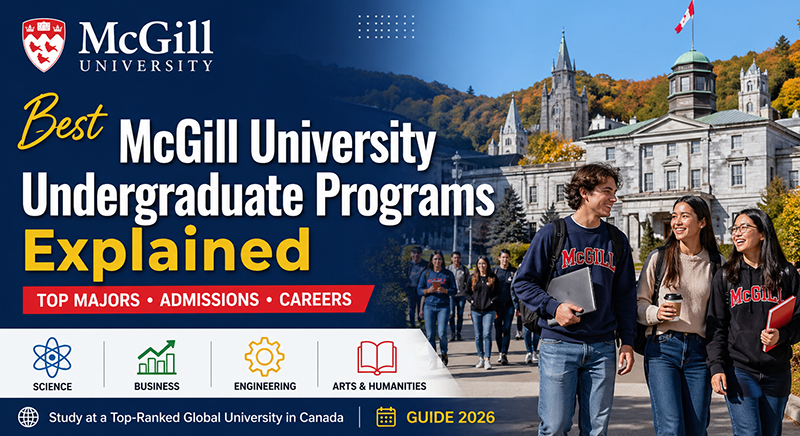
Introduction
McGill University is one of Canada’s most prestigious and internationally recognized universities, located in Montreal, Quebec. Known for its academic excellence, research output, and diverse student body, McGill consistently ranks among the top universities worldwide.
For undergraduate students, McGill offers a wide range of programs across arts, science, engineering, business, and health sciences. Choosing the right program is one of the most important decisions for prospective students, especially those aiming for competitive global careers.
In this guide, we break down the best McGill University undergraduate programs, what makes them stand out, admission requirements, tuition expectations, and career outcomes.
Why Study at McGill University?
Before exploring specific programs, it’s important to understand why McGill is such a strong choice for undergraduate studies:
1. Global Reputation
McGill is consistently ranked among the top 30 universities worldwide and is often called “Canada’s Ivy League equivalent.”
2. Research Excellence
Students gain access to world-class research facilities even at the undergraduate level.
3. Diverse Student Community
McGill attracts students from over 150 countries, creating a highly international learning environment.
4. Strong Employment Outcomes
Graduates are highly sought after in industries like tech, finance, medicine, law, and engineering.
5. Location Advantage
Montreal is one of the most affordable and student-friendly cities in North America.
Best McGill University Undergraduate Programs
Below are the top undergraduate programs that consistently attract high demand and strong career outcomes.
1. Bachelor of Science (BSc) – Computer Science
One of the most competitive and popular programs at McGill.
Why it stands out:
- Strong focus on algorithms, AI, and software engineering
- High employability in tech industry
- Access to research labs and internships
Career paths:
- Software Engineer
- Data Scientist
- AI/ML Engineer
- Systems Analyst
Ideal for:
Students interested in technology, coding, and problem-solving.
2. Bachelor of Commerce (BCom)
Offered by the Desautels Faculty of Management, this is one of McGill’s most prestigious business programs.
Key features:
- Finance, marketing, accounting, and analytics streams
- Strong global internship network
- Case-based learning approach
Career paths:
- Investment Banking
- Management Consulting
- Marketing Manager
- Financial Analyst
3. Bachelor of Science – Biology & Life Sciences
A top choice for students aiming for medical school or research careers.
Highlights:
- Strong lab-based curriculum
- Research opportunities in genetics, ecology, and neuroscience
- Pathway to medicine and health sciences
Career paths:
- Medical School
- Biomedical Research
- Pharmaceutical Industry
- Biotechnology
4. Bachelor of Engineering (BEng)
McGill’s engineering programs are highly respected worldwide.
Specializations include:
- Mechanical Engineering
- Electrical Engineering
- Civil Engineering
- Software Engineering
Why students choose it:
- Hands-on design projects
- Industry internships
- Strong salary outcomes after graduation
5. Bachelor of Arts (BA) – Economics
Economics is one of McGill’s most academically rigorous and popular Arts programs.
Focus areas:
- Microeconomics
- Macroeconomics
- Econometrics
- International trade
Career paths:
- Economist
- Policy Analyst
- Data Analyst
- Graduate studies (MBA, Law, Economics PhD)
6. Bachelor of Science – Psychology
Highly competitive program for students interested in human behavior and mental health.
Key benefits:
- Research-based curriculum
- Cognitive neuroscience opportunities
- Strong preparation for graduate studies
Career paths:
- Clinical Psychology (graduate required)
- UX Researcher
- HR Specialist
- Behavioral Analyst
7. Bachelor of Arts – Political Science
A strong program for students interested in law, government, and international relations.
Why it’s popular:
- Access to Canadian and global policy research
- Internship opportunities in government and NGOs
- Strong law school preparation
Career paths:
- Lawyer (with further studies)
- Diplomat
- Policy Advisor
- Political Analyst
8. Bachelor of Science – Neuroscience
One of McGill’s most advanced interdisciplinary programs.
Focus areas:
- Brain function and cognition
- Neurobiology
- Cognitive psychology
Career paths:
- Neuroscientist
- Medical Doctor
- Research Scientist
- Pharmaceutical development
9. Bachelor of Arts – English Literature
A strong humanities program known for critical thinking and writing excellence.
Key benefits:
- Literary analysis and theory
- Writing and communication skills
- Preparation for law, media, and publishing
Career paths:
- Writer / Editor
- Journalist
- Lawyer
- Communications Specialist
10. Bachelor of Science – Mathematics & Statistics
Highly analytical and respected program.
Highlights:
- Pure mathematics and applied statistics
- Data science and quantitative modeling
- Strong graduate school preparation
Career paths:
- Data Scientist
- Actuary
- Financial Analyst
- Academic Researcher
Admission Requirements for McGill Undergraduate Programs
Admission varies by program, but general requirements include:
Academic Requirements:
- High school diploma (or equivalent)
- Strong GPA (typically 85–95%+ depending on program)
- Subject prerequisites (math, sciences for STEM programs)
English Language Requirements:
- IELTS: 6.5–7.0+
- TOEFL iBT: 90–100+
Additional Requirements:
- Personal statement (for some programs)
- Portfolio (for arts/design-related fields)
Tuition Fees for Undergraduate Students
Tuition at McGill varies depending on residency:
Estimated Annual Tuition:
- Quebec residents: CAD $3,000 – $4,000
- Other Canadian provinces: CAD $8,000 – $12,000
- International students: CAD $25,000 – $60,000+
Additional costs:
- Housing: CAD $10,000 – $18,000/year
- Living expenses: CAD $8,000 – $12,000/year
Career Outcomes After McGill
Graduates from McGill are highly competitive in global job markets.
Top industries:
- Technology (Google, Amazon, Microsoft)
- Finance (Goldman Sachs, JP Morgan)
- Healthcare & Medicine
- Government & Policy
- Academia & Research
Average outcomes:
- High graduate school acceptance rates
- Strong starting salaries in STEM and business fields
- Global alumni network in over 180 countries
Why McGill Undergraduate Programs Stand Out
McGill is not just about academic prestige—it is about:
- Research-driven education
- International exposure
- Strong career pathways
- Flexible interdisciplinary learning
This combination makes McGill one of the best universities in Canada for undergraduate education.
FAQ – McGill University Undergraduate Programs
1. Is McGill hard to get into?
Yes, McGill is competitive, especially for programs like Computer Science, Engineering, and Commerce.
2. What is McGill best known for?
McGill is best known for medicine, engineering, business, and science programs.
3. Can international students apply to McGill?
Yes, McGill has a large international student population from over 150 countries.
4. What GPA is required for McGill?
Most programs require a strong academic record, typically 85% or higher equivalent.
5. Is McGill good for engineering?
Yes, McGill Engineering is globally respected and highly ranked.
6. Does McGill offer scholarships?
Yes, McGill offers entrance scholarships and financial aid for eligible students.
RELATED ARTICLES:
1. What Is McGill University Acceptance Rate? Latest Data Explained
2. How Does McGill University Grading System Work? Full Guide
3. McGill University Diploma Explained: Requirements & Value