
Introduction
The McGill University grading system is one of the most important academic frameworks international students need to understand before studying in Canada. As one of Canada’s top universities, McGill uses a structured letter-grade and GPA-based system that evaluates student performance across courses, programs, and degrees.
Unlike percentage-only systems used in some countries, McGill combines letter grades, grade points, GPA (Grade Point Average), and CGPA (Cumulative GPA) to measure academic achievement. This guide explains everything in detail so you can understand how grades are calculated, what counts as passing, and how GPA impacts your academic progress.
1. Overview of McGill University Grading System
McGill uses a letter grading system combined with a 4.0 GPA scale. Each letter grade corresponds to a numeric value used to calculate GPA.
Basic Structure:
- Letter grades (A, B, C, D, F)
- Grade points (0.0 to 4.0 scale)
- GPA (per course or semester)
- CGPA (overall academic performance)
The system ensures consistency across faculties such as Arts, Science, Engineering, and Management.
2. McGill Letter Grades Explained
McGill assigns letter grades based on student performance in exams, assignments, and coursework.
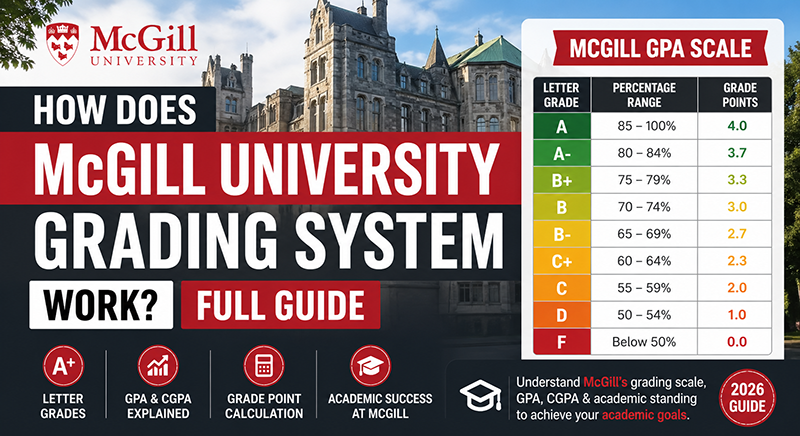
Typical Grade Scale:
| Letter Grade | Percentage Range | Grade Points |
|---|---|---|
| A | 85–100% | 4.0 |
| A- | 80–84% | 3.7 |
| B+ | 75–79% | 3.3 |
| B | 70–74% | 3.0 |
| B- | 65–69% | 2.7 |
| C+ | 60–64% | 2.3 |
| C | 55–59% | 2.0 |
| D | 50–54% | 1.0 |
| F | Below 50% | 0.0 |
Note: Exact grading cutoffs may vary slightly depending on the faculty or course.
3. How McGill GPA System Works
The McGill GPA system is based on a 4.0 scale, where each course grade is converted into grade points.
GPA Formula:
GPA = Total Grade Points Earned ÷ Total Credits Attempted
Each course contributes differently depending on its credit weight (e.g., 3-credit or 4-credit course).
Example:
- Course A: A (4.0) × 3 credits = 12
- Course B: B+ (3.3) × 3 credits = 9.9
- Course C: B (3.0) × 4 credits = 12
Total points = 33.9
Total credits = 10
GPA = 33.9 ÷ 10 = 3.39
4. What Is CGPA at McGill?
CGPA (Cumulative Grade Point Average) represents your overall academic performance across all semesters.
Key Features:
- Includes all completed courses
- Updated each semester
- Critical for scholarships, internships, and graduation
A strong CGPA is essential for competitive programs like medicine, law, and engineering.
5. Passing Grades at McGill University
At McGill, the minimum passing grade depends on the program:
General Rule:
- D (50–54%) = minimum passing grade
- Some programs require C or higher in core courses
Important Notes:
- F grade = failure, must retake course
- Some faculties enforce stricter academic standing rules
- Repeated failures may lead to academic probation
6. McGill Academic Standing System
McGill also evaluates students through academic standing:
Categories:
- Good Standing: CGPA meets requirement
- Probation: CGPA below threshold
- Unsatisfactory Standing: risk of dismissal
Maintaining a strong GPA is essential to remain in good academic standing.
7. Differences Between McGill and Other Grading Systems
Compared to other universities, McGill’s system is:
1. More GPA-focused
Unlike purely percentage-based systems, McGill emphasizes GPA consistency.
2. Standardized grading scale
All faculties use a unified 4.0 GPA conversion.
3. Competitive grading environment
High-achieving students often aim for B+ and above.
8. Tips to Improve Your GPA at McGill
Here are practical strategies:
Study Strategies:
- Focus on high-credit courses first
- Attend lectures consistently
- Review grading rubrics carefully
Academic Habits:
- Start assignments early
- Use office hours for clarification
- Join study groups
Exam Preparation:
- Practice past exams
- Understand marking schemes
- Manage time effectively
9. Why McGill Grading System Matters
Understanding the grading system is crucial because it affects:
- Graduate school applications
- Scholarships and awards
- Internship opportunities
- Job competitiveness
A strong GPA can significantly improve academic and career prospects.
FAQ – McGill University Grading System
1. What is the McGill grading scale?
McGill uses a letter-grade system (A–F) converted into a 4.0 GPA scale.
2. What GPA is considered good at McGill?
A GPA of 3.0 or higher is generally considered good, while 3.5+ is competitive.
3. Is 50% a passing grade at McGill?
Yes, 50% (D grade) is usually the minimum passing mark, but some programs require higher.
4. How is CGPA calculated at McGill?
CGPA is calculated by averaging all course grade points weighted by credits.
5. Does McGill use percentage or GPA?
McGill uses both internally, but official evaluation is based on GPA.
6. Can I retake a failed course at McGill?
Yes, failed courses can typically be retaken depending on faculty rules.
Conclusion
The McGill University grading system is designed to fairly evaluate academic performance using a combination of letter grades and a 4.0 GPA scale. Understanding how GPA and CGPA are calculated helps students plan their studies more effectively and achieve stronger academic outcomes.
Whether you are a prospective student or currently enrolled, mastering this grading system is essential for academic success at McGill.