
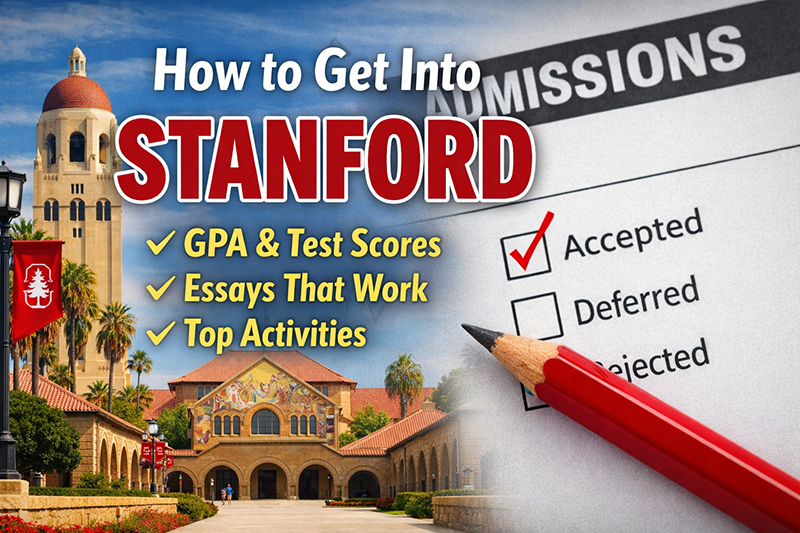
Introduction: Why Stanford University Is So Competitive
If you are aiming for one of the most prestigious universities in the world, understanding Stanford admission requirements is essential. Located in the heart of Silicon Valley, Stanford University is known for innovation, entrepreneurship, and academic excellence. However, getting in is extremely competitive, with acceptance rates typically below 5%.
In this complete guide, you’ll learn how to get into Stanford, including GPA expectations, test scores, extracurricular strategies, and essay tips. We’ll also compare Stanford with Harvard University to help you understand the differences in admission difficulty.
Stanford Admission Overview (2026)
Before diving into strategy, here’s a quick overview of Stanford’s key admission metrics:
| Category | Details |
|---|---|
| Acceptance Rate | ~3.5%–4% |
| Application Platform | Common App / Coalition App |
| Test Policy | Test-Optional |
| Average GPA | 3.9+ (unweighted) |
| TOEFL | 100+ recommended |
| IELTS | 7.5+ recommended |
Stanford evaluates applicants holistically, meaning academic performance is just one part of the equation.
GPA Requirements: How High Is “High Enough”?
When discussing how to get into Stanford, GPA is one of the most critical factors.
What Stanford Looks For:
- Near-perfect GPA (3.9–4.0 unweighted)
- Strong performance in AP, IB, or honors courses
- Academic rigor matters as much as grades
Competitive GPA Breakdown
| GPA Range | Competitiveness |
|---|---|
| 3.95–4.0 | Highly Competitive |
| 3.85–3.94 | Competitive |
| Below 3.8 | Risky unless exceptional elsewhere |
Pro Tip: Stanford values intellectual vitality, not just perfect grades. Taking challenging courses and excelling in them is key.
SAT/ACT Requirements: Is Stanford Test-Optional?
A common question about Stanford admission requirements is whether standardized tests are required.
Current Policy:
- Stanford is test-optional (as of recent cycles)
- You can apply without SAT/ACT scores
Should You Submit Scores?
| Score Range | Recommendation |
|---|---|
| SAT 1500+ | Submit |
| SAT 1450–1500 | Consider submitting |
| Below 1450 | Optional / Skip |
Even though optional, strong scores still provide an advantage, especially for international students.
Key Insight: Test-optional does NOT mean test-irrelevant.
English Proficiency: TOEFL & IELTS Requirements
For international applicants, language proficiency is a core part of Stanford admission requirements.
Accepted Tests:
- TOEFL (preferred)
- IELTS
- Duolingo (in some cases)
Recommended Scores:
| Test | Competitive Score |
|---|---|
| TOEFL | 100–110+ |
| IELTS | 7.5–8.0 |
| Duolingo | 130+ |
Stanford does not always state strict minimums, but competitive applicants typically exceed these ranges.
Extracurricular Activities: The Real Differentiator
If there’s one factor that truly defines how to get into Stanford, it’s extracurricular activities.
Stanford looks for:
- Depth over breadth
- Leadership and initiative
- Real-world impact
What “Strong Activities” Look Like:
| Type | Example |
|---|---|
| Leadership | Founder of a startup or nonprofit |
| Research | Published academic paper |
| Innovation | App development / patents |
| Impact | Community projects with measurable results |
Unlike many schools, Stanford heavily favors “spike profiles”—students who excel deeply in one area.
Stanford Essays: What Makes Them Unique?
The Stanford essays are one of the most important parts of your application.
Key Characteristics:
- Highly personal
- Reflect intellectual curiosity
- Show authenticity and individuality
Typical Essay Prompts:
- What matters to you and why?
- Why Stanford?
- Short answer questions (quirky and creative)
What Stanford Wants:
- Self-awareness
- Original thinking
- Genuine voice (not over-polished)
Common Mistake: Writing what you think admissions officers want to hear instead of being authentic.
Stanford vs Harvard University: Which Is Harder?
Many students compare Stanford with Harvard when evaluating admission difficulty.
Acceptance Rate Comparison:
| University | Acceptance Rate |
|---|---|
| Stanford | ~3.5%–4% |
| Harvard | ~3.5%–4.5% |
Key Differences:
| Factor | Stanford | Harvard |
|---|---|---|
| Focus | Innovation & entrepreneurship | Academic excellence & tradition |
| Essays | More personal & creative | More structured |
| Activities | Spike-focused | Well-rounded + leadership |
| Culture | Silicon Valley, startup-driven | Ivy League, academic prestige |
Conclusion:
Both are extremely competitive, but:
- Stanford favors innovators and builders
- Harvard favors academic excellence + leadership balance
How to Get Into Stanford: Step-by-Step Strategy
1. Build a Strong Academic Foundation
- Aim for a GPA above 3.9
- Take the most rigorous courses available
2. Develop a “Spike”
- Focus deeply on one passion (tech, research, business, etc.)
3. Create Impact
- Launch projects, not just join clubs
- Show measurable results
4. Write Authentic Essays
- Be personal, reflective, and unique
5. Secure Strong Recommendations
- Choose teachers who know you well
- Highlight character and intellectual curiosity
Common Mistakes to Avoid
When applying to Stanford, avoid these pitfalls:
- Focusing only on grades
- Listing too many shallow activities
- Writing generic essays
- Ignoring personality and authenticity
Stanford rejects many “perfect” students because they lack uniqueness.
Final Thoughts: Is Stanford Right for You?
Getting into Stanford University is incredibly challenging, but not impossible. The key is to go beyond traditional metrics and demonstrate who you truly are.
If you’re aiming to succeed:
- Focus on impact, not just achievement
- Build a clear personal narrative
- Show why you belong at Stanford
When comparing with Harvard University, remember: It’s not about which school is “easier,” but which one fits your strengths. If you can’t get your original Stanford University diploma or transcript, please contact us to get your own documents & certificates online.