
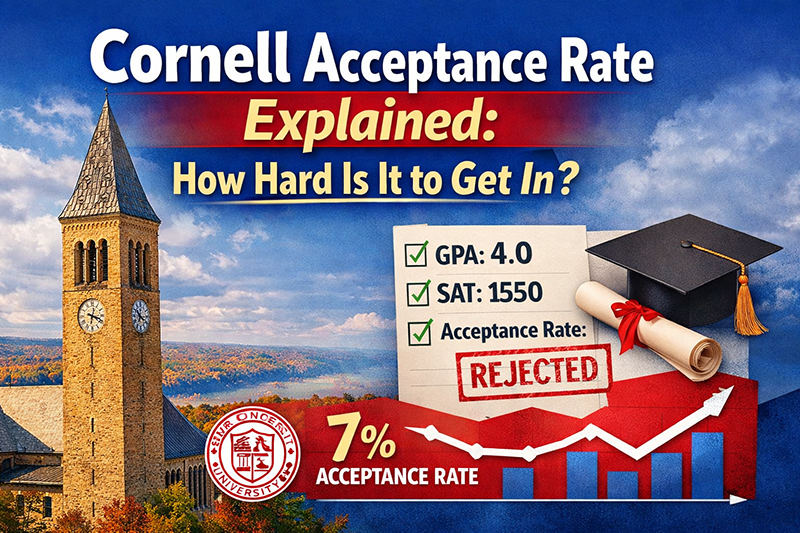
Cornell University is one of the most prestigious Ivy League schools in the United States, known for its academic excellence, world-class faculty, and highly selective admissions process. Every year, tens of thousands of students apply, but only a small percentage are accepted.
In this comprehensive guide, we break down the Cornell acceptance rate, admissions trends, academic expectations, and strategies to improve your chances of getting in.
Cornell Acceptance Rate (Latest 2026 Overview)
Cornell is consistently one of the most selective Ivy League universities. Its acceptance rate has remained low due to increasing global applications and limited enrollment capacity.
Cornell Acceptance Rate Table (Recent Years)
| Year | Applications | Admitted Students | Acceptance Rate |
|---|---|---|---|
| 2022 | ~71,000 | ~5,500 | ~7.7% |
| 2023 | ~69,000 | ~5,200 | ~7.5% |
| 2024 | ~72,000 | ~5,400 | ~7.5% |
| 2025 | ~68,000 | ~5,300 | ~7.8% |
| 2026 (est.) | ~70,000+ | ~5,000–5,500 | ~7%–8% |
Key Insight: Cornell’s acceptance rate typically stays between 7% and 9%, making it one of the most competitive Ivy League schools.
Why Is Cornell University So Hard to Get Into?
The low acceptance rate is not random—it reflects several key factors:
1. Ivy League Reputation
Cornell is part of the Ivy League, which automatically attracts high-achieving students globally.
2. Massive Application Volume
Every year, Cornell receives tens of thousands of applications from:
- Top U.S. high school students
- International applicants
- Transfer students
- Early Decision applicants
3. Limited Class Size
Even though demand is high, Cornell can only enroll a limited number of students each year.
4. School Diversity (Colleges within Cornell)
Cornell is unique because it has multiple colleges, including:
- College of Arts & Sciences
- College of Engineering
- Dyson School of Applied Economics and Management
- College of Architecture, Art, and Planning
Each college has different acceptance rates, some significantly lower than others.
Cornell Acceptance Rate by College
Not all programs at Cornell are equally competitive.
Selectivity by College
| College | Estimated Acceptance Rate | Competitiveness |
|---|---|---|
| College of Arts & Sciences | ~8% | Very High |
| College of Engineering | ~6% | Extremely High |
| Dyson School (Business) | ~3%–4% | Ultra Competitive |
| College of Agriculture & Life Sciences | ~11% | High |
| School of Hotel Administration | ~15% | Moderately Competitive |
Insight: Programs like Dyson and Engineering are among the most selective undergraduate programs in the Ivy League.
Cornell Acceptance Rate vs Other Ivy League Schools
To understand how competitive Cornell is, it helps to compare it with other Ivy League institutions.
Ivy League Acceptance Rate Comparison
| University | Acceptance Rate |
|---|---|
| Harvard University | ~3–4% |
| Columbia University | ~3–4% |
| Yale University | ~4–5% |
| Princeton University | ~4–5% |
| University of Pennsylvania | ~5–6% |
| Dartmouth College | ~6–7% |
| Brown University | ~5–6% |
| Cornell University | ~7–8% |
Cornell is slightly less selective than Harvard or Columbia but still firmly within the “extremely competitive” elite tier.
What GPA Do You Need for Cornell?
Admission is not just about acceptance rate—it’s about academic excellence.
Typical Academic Profile of Admitted Students:
- Average GPA: 3.9–4.0 (unweighted)
- SAT Score: 1450–1560
- ACT Score: 33–35
- Top 10% of high school class: Nearly all admitted students
Cornell expects applicants to be among the strongest students in their school.
What Cornell Looks for in Applicants
Cornell uses a holistic admissions process, meaning they evaluate more than grades.
Key Factors:
1. Academic Rigor
AP, IB, Honors, and advanced coursework matter heavily.
2. Extracurricular Activities
Strong applicants often show:
- Leadership roles
- National competitions
- Research experience
- Entrepreneurship or innovation
3. Personal Essays
Cornell values essays that show:
- Intellectual curiosity
- Personal growth
- Clear academic direction
4. Letters of Recommendation
Strong teacher recommendations can significantly boost your application.
5. Fit with College
Each Cornell school evaluates applicants differently based on program fit.
How to Get Into Cornell University (Strategic Guide)
If you want to improve your chances, focus on these strategies:
1. Maintain a High GPA
Aim for near-perfect academic performance in challenging courses.
2. Build a Strong Academic Niche
Cornell prefers students with a clear academic identity (e.g., engineering, business, biology).
3. Excel in Extracurriculars
Depth matters more than quantity:
- 1–2 leadership roles are better than 10 passive activities
4. Write Powerful Essays
Avoid generic writing. Show:
- Personal challenges
- Academic passion
- Future goals
5. Apply Early Decision (If Possible)
Cornell’s Early Decision acceptance rate is typically higher than Regular Decision.
Early Decision vs Regular Decision Acceptance Rate
| Application Type | Acceptance Rate |
|---|---|
| Early Decision | ~15%–20% |
| Regular Decision | ~6%–8% |
Applying Early Decision can significantly improve your chances if Cornell is your top choice.
Most Competitive Majors at Cornell
Some programs are significantly harder to get into:
Top Competitive Majors:
- Computer Science
- Economics (Dyson School)
- Engineering fields
- Business Analytics
- Architecture
These programs often have acceptance rates far below the university average.
Why Cornell Acceptance Rate Keeps Dropping
Several long-term trends contribute:
- Rising international applications
- Increased visibility of Ivy League schools
- Test-optional policies increasing applications
- Strong global reputation in STEM and business
As applications increase, acceptance rate naturally decreases.
Is Cornell Worth the Difficulty?
Despite the low acceptance rate, Cornell offers strong return on investment:
Career Outcomes:
- High employment rate after graduation
- Strong recruitment from top companies (Google, Goldman Sachs, Amazon)
- Alumni network across global industries
Average Starting Salary:
- ~$85,000–$120,000 depending on major
- Higher for Engineering and Dyson graduates
Frequently Asked Questions (FAQ)
1. What is Cornell University acceptance rate in 2026?
The estimated acceptance rate is around 7%–8%, making it highly selective.
2. Is Cornell harder to get into than other Ivy League schools?
Cornell is slightly less selective than Harvard or Columbia but still extremely competitive.
3. What GPA do I need for Cornell?
Most admitted students have a 3.9–4.0 GPA with rigorous coursework.
4. Does Early Decision improve chances?
Yes. Early Decision acceptance rates are significantly higher than Regular Decision.
5. Which Cornell college is easiest to get into?
Colleges like Agriculture & Life Sciences and Hotel Administration tend to have higher acceptance rates.
6. Is Cornell test-optional?
Policies may change yearly, but test-optional admissions have been available in recent cycles.
Conclusion
Cornell University remains one of the most prestigious and competitive universities in the world. If you need a Cornell University diploma with transcript without taking exams, we can assit with you. With an acceptance rate hovering around 7%–8%, gaining admission requires academic excellence, strong extracurriculars, and a compelling personal story.
While the process is challenging, understanding the admissions landscape—and strategically preparing your application—can significantly improve your chances. If Cornell is your dream school, focus early, stay consistent, and aim for excellence in every aspect of your application.