
Carnegie Mellon University is one of the most selective and prestigious universities in the United States. Known worldwide for computer science, engineering, robotics, drama, and business, Carnegie Mellon attracts thousands of high-achieving applicants every year. While the university’s overall acceptance rate is already low, admission difficulty varies significantly depending on the major or college you apply to. Programs like Computer Science and Drama are much more competitive than some humanities or interdisciplinary majors. In this guide, you’ll learn everything about the Carnegie Mellon University acceptance rate by major, including:
- Overall admission statistics
- Acceptance rates for popular majors
- GPA and SAT expectations
- Most competitive CMU schools
- International student admission insights
- Tips to improve your admission chances
Whether you are applying to Computer Science, Engineering, Business, or Fine Arts, this article will help you understand how competitive Carnegie Mellon admissions really are.
Carnegie Mellon University Overview
Founded in 1900, Carnegie Mellon University is located in Pittsburgh, Pennsylvania. The university is especially famous for innovation in technology, artificial intelligence, robotics, and performing arts.
Quick Facts About Carnegie Mellon
| Category | Details |
|---|---|
| Location | Pittsburgh, Pennsylvania |
| Type | Private Research University |
| Undergraduate Enrollment | ~7,500 |
| Total Enrollment | ~15,000 |
| Known For | CS, Engineering, Drama, Robotics |
| Ranking | Top 25 National University |
| Mascot | Scotty the Scottie Dog |
Carnegie Mellon consistently ranks among the top universities globally for STEM and performing arts programs.
Carnegie Mellon University Overall Acceptance Rate
The overall acceptance rate at Carnegie Mellon University is generally around 11%–13% in recent admission cycles.
Recent CMU Admission Statistics
| Admission Year | Applicants | Accepted Students | Acceptance Rate |
|---|---|---|---|
| 2022 | 34,000+ | 3,900 | ~11% |
| 2023 | 33,700+ | 4,000 | ~12% |
| 2024 | 34,500+ | 4,100 | ~12% |
The university receives applications from top students worldwide, making admissions highly competitive.
However, acceptance rates differ dramatically by major and college.
Carnegie Mellon University Acceptance Rate by Major
The most important thing applicants should understand is that Carnegie Mellon admissions are often school-specific.
Some colleges inside CMU are significantly harder to enter than others.
Estimated Carnegie Mellon Acceptance Rate by Major
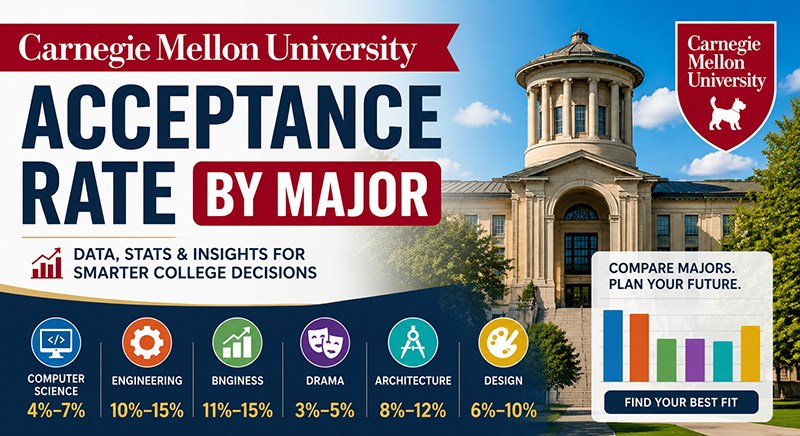
| Major / School | Estimated Acceptance Rate | Difficulty Level |
|---|---|---|
| Computer Science | 4%–7% | Extremely Competitive |
| School of Drama | 3%–5% | Extremely Competitive |
| Engineering | 10%–15% | Very Competitive |
| Business (Tepper) | 11%–15% | Very Competitive |
| Architecture | 8%–12% | Highly Competitive |
| Design | 6%–10% | Highly Competitive |
| Information Systems | 12%–18% | Competitive |
| Mathematics | 10%–15% | Very Competitive |
| Humanities & Social Sciences | 15%–20% | Moderately Competitive |
| Fine Arts | 5%–10% | Highly Competitive |
These numbers are estimated from institutional data, admissions trends, and applicant competitiveness.
Carnegie Mellon Computer Science Acceptance Rate
The Carnegie Mellon University School of Computer Science is one of the most competitive computer science schools in the world.
Why CMU Computer Science Is So Competitive
CMU is globally recognized for:
- Artificial Intelligence
- Robotics
- Machine Learning
- Cybersecurity
- Software Engineering
- Human-Computer Interaction
Major tech companies actively recruit CMU graduates.
Estimated Computer Science Acceptance Rate
| Program | Estimated Acceptance Rate |
|---|---|
| School of Computer Science | 4%–7% |
| Artificial Intelligence Major | Below 5% |
| Robotics Major | Around 5% |
Students applying to CS usually have:
- Near-perfect GPAs
- Advanced math coursework
- Exceptional programming experience
- Strong extracurricular achievements
Carnegie Mellon Engineering Acceptance Rate
The Carnegie Mellon University College of Engineering is another highly selective division.
Popular Engineering Majors
- Mechanical Engineering
- Electrical Engineering
- Biomedical Engineering
- Chemical Engineering
- Civil Engineering
Estimated Engineering Acceptance Rate
| Engineering Major | Estimated Acceptance Rate |
|---|---|
| Electrical Engineering | 10%–12% |
| Mechanical Engineering | 11%–14% |
| Biomedical Engineering | 9%–12% |
| Civil Engineering | 12%–15% |
Engineering applicants typically need strong STEM backgrounds and advanced math preparation.
Carnegie Mellon Business School Acceptance Rate
The Tepper School of Business at Carnegie Mellon University is known for analytics, finance, and quantitative business education.
Tepper School Admission Competitiveness
| Program | Estimated Acceptance Rate |
|---|---|
| Undergraduate Business | 11%–15% |
| Economics | 13%–18% |
| Computational Finance | Very Selective |
Strong applicants often demonstrate:
- Leadership experience
- Quantitative skills
- High SAT/ACT scores
- Business-related extracurriculars
Carnegie Mellon Drama School Acceptance Rate
The School of Drama is one of the oldest conservatory-style drama schools in the United States.
It is also among the hardest arts programs to enter.
Estimated Drama Acceptance Rate
| Program | Acceptance Rate |
|---|---|
| Acting | 3%–4% |
| Musical Theater | 2%–3% |
| Directing | 4%–6% |
Applicants must complete:
- Auditions
- Portfolios
- Interviews
- Artistic evaluations
Talent matters just as much as academics in these programs.
Carnegie Mellon GPA Requirements
Although CMU does not officially publish a minimum GPA, most admitted students are academically exceptional.
Average GPA of Admitted Students
| Program Type | Typical GPA |
|---|---|
| Computer Science | 3.9–4.0 |
| Engineering | 3.8–4.0 |
| Business | 3.8+ |
| Humanities | 3.7+ |
Most successful applicants rank near the top of their graduating class.
Carnegie Mellon SAT and ACT Scores
Standardized test scores remain very strong among admitted students.
Typical SAT Scores
| Section | Middle 50% Range |
|---|---|
| Evidence-Based Reading & Writing | 730–760 |
| Math | 770–800 |
| Total SAT | 1480–1560 |
Typical ACT Scores
| Exam | Middle 50% Range |
|---|---|
| ACT Composite | 33–35 |
Computer Science applicants often score near-perfect math results.
Carnegie Mellon Acceptance Rate for International Students
Carnegie Mellon University attracts students from more than 100 countries.
International admissions are generally more competitive because of limited spots and high global demand.
What International Students Need
- Strong English proficiency
- Excellent grades
- Competitive SAT/ACT scores
- Impressive extracurricular activities
- Strong essays and recommendations
Popular majors among international students include:
- Computer Science
- Engineering
- Business Analytics
- Robotics
Carnegie Mellon Early Decision Acceptance Rate
Applying Early Decision (ED) may slightly improve your chances.
Early Decision vs Regular Decision
| Application Type | Estimated Acceptance Rate |
|---|---|
| Early Decision | 15%–18% |
| Regular Decision | 10%–12% |
Early Decision demonstrates strong commitment to attending CMU.
However, the applicant pool is also highly competitive.
Most Competitive Majors at Carnegie Mellon
Some majors consistently attract the strongest applicants worldwide.
Hardest Majors to Get Into
| Major | Difficulty |
|---|---|
| Computer Science | Extremely High |
| Artificial Intelligence | Extremely High |
| Drama | Extremely High |
| Design | Very High |
| Robotics | Very High |
| Architecture | Very High |
These programs evaluate applicants holistically, including portfolios, auditions, research, and technical skills.
Easiest Majors to Get Into at Carnegie Mellon
No program at Carnegie Mellon is truly “easy,” but some colleges have slightly higher acceptance rates.
Relatively Less Competitive Programs
| Program | Relative Difficulty |
|---|---|
| Humanities | Moderate |
| Social Sciences | Moderate |
| Interdisciplinary Studies | Moderate |
| Statistics | Competitive but Accessible |
Students should choose majors based on genuine interest, not simply acceptance rates.
Carnegie Mellon Transfer Acceptance Rate
Transfer admissions at CMU are limited.
Transfer Admission Statistics
| Category | Estimate |
|---|---|
| Transfer Acceptance Rate | 7%–10% |
| Most Competitive Transfer Programs | CS & Engineering |
Successful transfer applicants usually have:
- Outstanding college GPAs
- Strong prerequisite coursework
- Clear academic goals
How to Increase Your Chances of Getting Into Carnegie Mellon
Admission to Carnegie Mellon University requires more than just good grades.
1. Maintain an Exceptional GPA
Competitive applicants typically earn mostly A grades in rigorous courses.
Take:
- AP classes
- IB courses
- Honors coursework
especially in math and science.
2. Build a Strong Extracurricular Profile
CMU values students with passion and impact.
Examples include:
- Coding competitions
- Robotics clubs
- Research projects
- Entrepreneurship
- Performing arts achievements
Depth matters more than quantity.
3. Write Outstanding Essays
Your essays should demonstrate:
- Intellectual curiosity
- Creativity
- Personal growth
- Clear academic goals
Avoid generic responses.
4. Demonstrate Fit for Your Major
CMU strongly prefers applicants who already show interest and experience related to their intended field.
For example:
| Major | Helpful Activities |
|---|---|
| Computer Science | Coding projects |
| Drama | Theater performances |
| Engineering | STEM competitions |
| Business | Leadership initiatives |
5. Earn Strong Recommendations
Recommendations should highlight:
- Academic excellence
- Work ethic
- Leadership
- Creativity
Teacher recommendations are particularly important for competitive majors.
Carnegie Mellon vs Other Top Universities
Students often compare CMU to other elite institutions.
Acceptance Rate Comparison
| University | Acceptance Rate |
|---|---|
| Carnegie Mellon University | ~11% |
| Stanford University | ~4% |
| Massachusetts Institute of Technology | ~4% |
| University of Southern California | ~10% |
| New York University | ~8% |
While CMU may have a slightly higher overall acceptance rate than some Ivy-level institutions, top majors like Computer Science can be equally selective.
Is Carnegie Mellon Worth It?
For many students, the answer is yes.
Benefits of Attending Carnegie Mellon
- World-class STEM education
- Exceptional career outcomes
- Strong employer reputation
- Access to top tech companies
- High starting salaries
Graduates often work at companies like:
- Apple
- Microsoft
- Meta
- Amazon
CMU’s reputation in technology and innovation remains among the strongest globally.
Frequently Asked Questions
What is Carnegie Mellon University’s overall acceptance rate?
The overall acceptance rate is typically around 11%–13%.
What is the hardest major to get into at Carnegie Mellon?
Computer Science and Drama are generally considered the most competitive programs.
What GPA do you need for Carnegie Mellon?
Most admitted students have GPAs between 3.8 and 4.0.
Is Carnegie Mellon harder to get into than Ivy League schools?
Some CMU majors, especially Computer Science, can be as competitive as Ivy League programs.
Does Carnegie Mellon require SAT scores?
CMU’s testing policies may vary by year, so students should check official admissions requirements.
Is Carnegie Mellon good for international students?
Yes. Carnegie Mellon has a large international student population and strong global recognition.
Final Thoughts
The Carnegie Mellon University acceptance rate by major varies significantly depending on the program you choose. While the university’s overall admission rate is already competitive, majors like Computer Science, Drama, Robotics, and Design are especially difficult to enter.
Students hoping to gain admission should focus on:
- Academic excellence
- Rigorous coursework
- Meaningful extracurricular activities
- Strong essays
- Demonstrated passion for their intended major
Carnegie Mellon rewards students who combine intellectual ability with creativity, innovation, and determination.
If you prepare strategically and apply thoughtfully, you can significantly improve your chances of joining one of the world’s top universities.