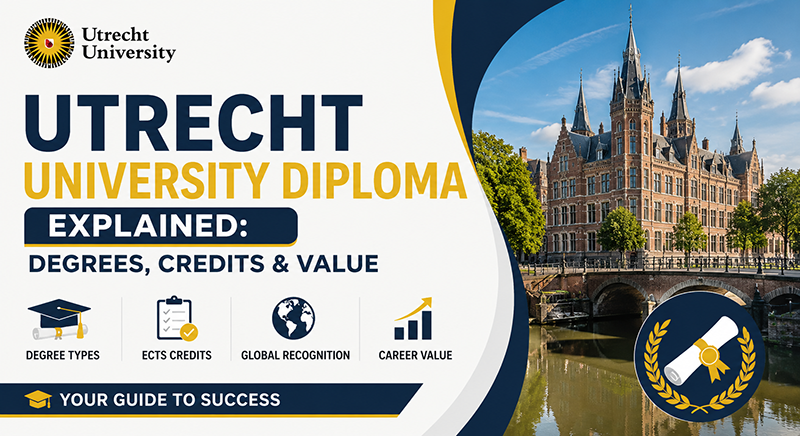
A diploma from Utrecht University is recognized across Europe and respected worldwide for its academic quality, research strength, and international focus. Whether you are planning to pursue a bachelor’s degree, master’s degree, exchange program, or PhD in the Netherlands, understanding how the Utrecht University diploma system works can help you make better academic and career decisions.
This guide explains everything you need to know about Utrecht University diplomas, including degree structures, ECTS credits, graduation requirements, international recognition, diploma supplements, and the real-world value of earning a degree from one of Europe’s leading universities.
Table of Contents
- Introduction to Utrecht University
- What Is a Utrecht University Diploma?
- Types of Degrees Offered
- Understanding the Dutch ECTS Credit System
- Bachelor’s Degree Diplomas
- Master’s Degree Diplomas
- PhD Degrees at Utrecht University
- Diploma Supplement Explained
- International Recognition of Utrecht University Degrees
- Graduation Requirements
- Average Study Duration
- Language of Instruction
- Academic Grading System
- Online Verification and Authentication
- Career Value of a Utrecht University Diploma
- Comparison With Other European Universities
- Tuition Fees and Return on Investment
- Scholarships and Financial Aid
- Popular Degree Programs
- How Employers View Utrecht University Graduates
- Frequently Asked Questions
- Final Thoughts
Introduction to Utrecht University
Founded in 1636, Utrecht University is one of the oldest and most prestigious universities in Europe. Located in the historic city of Utrecht, the university consistently ranks among the top research institutions globally.
The university is known for:
- High academic standards
- Strong research output
- International student diversity
- Interdisciplinary education
- Innovative teaching methods
Today, thousands of international students choose Utrecht University for undergraduate, graduate, and doctoral studies.
What Is a Utrecht University Diploma?
A Utrecht University diploma is an official academic qualification awarded after successfully completing a degree program. The diploma certifies that a student has met all academic and institutional requirements.
The diploma generally includes:
| Diploma Component | Description |
|---|---|
| Degree Title | Bachelor, Master, or PhD |
| Program Name | Specific academic discipline |
| ECTS Credits | Total earned credits |
| Graduation Date | Official completion date |
| University Seal | Authentication from the university |
| Signatures | Faculty and university officials |
Graduates also receive a Diploma Supplement, which explains the qualification in an internationally recognized format.
Types of Degrees Offered
Utrecht University offers several academic qualifications.
| Degree Type | Typical Duration | ECTS Credits |
|---|---|---|
| Bachelor’s Degree | 3 years | 180 ECTS |
| Master’s Degree | 1–2 years | 60–120 ECTS |
| Research Master’s | 2 years | 120 ECTS |
| PhD | 4 years | Research-based |
The university follows the Bologna Process, making its degrees compatible with European higher education standards.
Understanding the Dutch ECTS Credit System
The Netherlands uses the European Credit Transfer and Accumulation System (ECTS).
180\ \text{ECTS} = 3\ \text{years of full-time bachelor study}
One academic year equals 60 ECTS credits.
Typically:
| Credits | Study Workload |
|---|---|
| 1 ECTS | Around 28 hours |
| 60 ECTS | One full academic year |
| 180 ECTS | Standard bachelor’s degree |
| 120 ECTS | Two-year master’s degree |
ECTS credits make transferring academic achievements across European universities much easier.
Bachelor’s Degree Diplomas
Bachelor’s programs at Utrecht University usually last three years.
Popular fields include:
- Economics
- Psychology
- Law
- Biology
- Media Studies
- Global Sustainability Science
- Linguistics
Students complete:
- Core courses
- Elective modules
- Research assignments
- Thesis projects
After graduation, students receive a Bachelor of Arts (BA) or Bachelor of Science (BSc) diploma.
Example Bachelor’s Structure
| Year | Focus Area |
|---|---|
| Year 1 | Foundation courses |
| Year 2 | Intermediate specialization |
| Year 3 | Advanced study + thesis |
The bachelor’s diploma allows students to pursue graduate education worldwide.
Master’s Degree Diplomas
Master’s programs are internationally respected and often research-focused.
Programs may last:
- 1 year (60 ECTS)
- 2 years (120 ECTS)
Common master’s degrees include:
| Degree | Field |
|---|---|
| MSc | Science & Technology |
| MA | Humanities & Social Sciences |
| LLM | Law |
| Research MSc | Advanced Research |
Students usually complete:
- Advanced seminars
- Research projects
- Internships
- Master’s thesis
Many programs are taught entirely in English.
PhD Degrees at Utrecht University
A PhD at Utrecht University is highly research-intensive.
Doctoral candidates:
- Conduct original research
- Publish academic papers
- Defend a dissertation publicly
- Work closely with supervisors
PhD graduates earn the title of “Doctor.”
The university is especially strong in:
- Life sciences
- Climate science
- Veterinary medicine
- Physics
- Humanities research
Diploma Supplement Explained
The Diploma Supplement is an important document accompanying the degree certificate.
It explains:
| Section | Information Included |
|---|---|
| Qualification Level | Bachelor/Master/PhD |
| Program Details | Courses and outcomes |
| Grading Scale | Dutch grading explanation |
| Institution Information | University accreditation |
| National Education System | Dutch higher education overview |
This supplement improves international recognition and simplifies admissions or employment abroad.
International Recognition of Utrecht University Degrees
A Utrecht University diploma is widely recognized internationally because the university is accredited by the Dutch government and aligned with European education standards.
Graduates commonly continue studies or work in:
- The United States
- Canada
- Germany
- Australia
- Singapore
- United Kingdom
The university’s global reputation helps graduates compete internationally.
Global Ranking Influence
International rankings strengthen the diploma’s value.
| Ranking Source | Approximate Position |
|---|---|
| QS World University Rankings | Top 150 |
| Times Higher Education | Top 100 |
| Shanghai Ranking | Top 60–70 |
Rankings vary yearly but consistently place Utrecht University among Europe’s elite institutions.
Graduation Requirements
Students must satisfy all academic requirements before receiving a diploma.
Typical requirements include:
- Passing all mandatory courses
- Achieving minimum ECTS credits
- Completing internships (if applicable)
- Submitting a thesis
- Meeting GPA or grade thresholds
Some programs may also require:
- Laboratory work
- Group projects
- Oral defense presentations
Average Study Duration
Most students graduate within the expected timeframe, although extensions are possible.
| Degree | Average Completion Time |
|---|---|
| Bachelor’s | 3–4 years |
| Master’s | 1–2 years |
| Research Master’s | 2 years |
| PhD | 4–6 years |
International students sometimes need additional time for thesis completion or internships.
Language of Instruction
Many programs are available fully in English.
Popular English-taught disciplines include:
- Artificial Intelligence
- Business Economics
- Environmental Sciences
- International Law
- Data Science
- Global Health
Dutch-language programs are also available, especially at undergraduate level.
English Requirements
International students usually need:
| Test | Common Minimum Score |
|---|---|
| IELTS | 6.5–7.0 |
| TOEFL iBT | 90–100 |
| Cambridge English | Accepted |
Requirements vary by department.
Academic Grading System
Dutch universities use a 1–10 grading scale.
\text{Passing Grade} \geq 6.0
Utrecht University Grading Scale
| Grade | Meaning |
|---|---|
| 10 | Outstanding |
| 9 | Excellent |
| 8 | Very Good |
| 7 | Good |
| 6 | Satisfactory |
| Below 6 | Fail |
Grades above 8 are considered impressive in the Dutch system.
Online Verification and Authentication
Employers and universities may verify diplomas through official university procedures.
Authentication methods may include:
- Digital verification systems
- Certified transcripts
- Apostille legalization
- Diploma supplements
Students should keep both physical and digital copies of documents.
Career Value of a Utrecht University Diploma
A diploma from Utrecht University provides strong career advantages.
Graduates are valued for:
- Research skills
- Critical thinking
- International perspective
- Academic independence
- English proficiency
Industries Employing Graduates
| Industry | Common Roles |
|---|---|
| Technology | Data analyst, researcher |
| Healthcare | Clinical researcher |
| Law | International legal advisor |
| Sustainability | Policy consultant |
| Education | Lecturer, academic researcher |
| Finance | Analyst, economist |
Employers often recognize Dutch university graduates as highly adaptable and academically rigorous.
Comparison With Other European Universities
Here is how Utrecht University compares with other respected European institutions.
| University | Country | Reputation | Research Strength |
|---|---|---|---|
| Utrecht University | Netherlands | Very High | Excellent |
| KU Leuven | Belgium | Very High | Excellent |
| University of Amsterdam | Netherlands | High | Strong |
| Heidelberg University | Germany | Excellent | Excellent |
| University of Copenhagen | Denmark | Very High | Strong |
Utrecht University is especially respected in interdisciplinary research and sustainability studies.
Tuition Fees and Return on Investment
Tuition varies based on nationality and degree level.
Estimated Tuition Costs
| Student Type | Annual Tuition |
|---|---|
| EU/EEA Students | Lower statutory fee |
| Non-EU Students | Higher institutional fee |
Additional expenses include:
- Housing
- Health insurance
- Transportation
- Study materials
Why Many Students Consider It Worthwhile
Graduates benefit from:
- Strong employability
- International recognition
- Access to European job markets
- Research opportunities
- Competitive salaries
Scholarships and Financial Aid
Several funding opportunities exist for international students.
Popular scholarships include:
| Scholarship | Eligibility |
|---|---|
| Utrecht Excellence Scholarship | Outstanding international students |
| Holland Scholarship | Non-EEA students |
| Erasmus+ | Exchange students |
| Faculty Scholarships | Program-specific |
Competition is usually intense, so early applications are important.
Popular Degree Programs
Some programs attract particularly high international interest.
Most Popular Programs
| Program | Degree Level |
|---|---|
| Psychology | Bachelor & Master |
| Data Science | Master |
| Sustainable Development | Master |
| Economics | Bachelor |
| Artificial Intelligence | Master |
| International Law | Master |
These programs often combine theoretical learning with practical research.
How Employers View Utrecht University Graduates
Employers often associate Utrecht University graduates with:
- Analytical thinking
- Independent learning
- Strong communication skills
- International awareness
- Research competence
The university’s emphasis on interdisciplinary education also helps graduates adapt to changing industries.
Graduate Employability
Many graduates work at:
- Multinational corporations
- NGOs
- Government agencies
- Research institutes
- Universities
- Tech startups
A Utrecht University diploma can therefore serve as a strong long-term career investment.
Challenges Students Should Know
While the diploma has high value, studying at Utrecht University can be academically demanding.
Common challenges include:
- Intensive reading loads
- Independent study expectations
- Research-focused assignments
- Strict grading standards
- Competitive admissions
However, many students find the academic experience rewarding.
Tips for Successfully Earning Your Diploma
1. Manage Your ECTS Carefully
60\ \text{ECTS per academic year}
Falling behind in credits may delay graduation.
2. Improve Academic Writing
Research essays and thesis work are central to Dutch higher education.
3. Participate in International Activities
Networking can improve both academic and career opportunities.
4. Use University Support Services
The university offers:
- Academic advisors
- Mental health support
- Career counseling
- Writing workshops
5. Plan Thesis Work Early
Strong thesis planning helps reduce graduation delays.
Frequently Asked Questions
Is a Utrecht University diploma recognized internationally?
Yes. Utrecht University degrees are internationally recognized and aligned with European higher education standards.
How many ECTS credits are required for graduation?
Most bachelor’s programs require 180 ECTS credits, while master’s programs require 60–120 ECTS.
Is Utrecht University difficult to graduate from?
The university is academically rigorous, but students who manage their coursework effectively usually succeed.
Are Utrecht University diplomas taught in English?
Many master’s programs and several bachelor’s programs are fully taught in English.
What is the value of a Utrecht University diploma in the job market?
Graduates are respected internationally for strong research and analytical skills.
Can I use a Utrecht University diploma in the United States or Canada?
Yes. Degrees are generally recognized by employers and universities in North America.
What documents come with the diploma?
Graduates typically receive:
- Official diploma
- Academic transcript
- Diploma Supplement
Does Utrecht University offer online degrees?
Some courses and blended-learning options exist, but most full degrees are campus-based.
Final Thoughts
A diploma from Utrecht University represents more than just academic completion. It reflects advanced research skills, international academic standards, and the ability to succeed in a rigorous educational environment.
Whether you pursue a bachelor’s, master’s, or PhD degree, Utrecht University offers strong global recognition, excellent research opportunities, and long-term career value. For international students seeking a respected European qualification, a Utrecht University diploma remains one of the most attractive academic credentials in the Netherlands and beyond.