Introduction
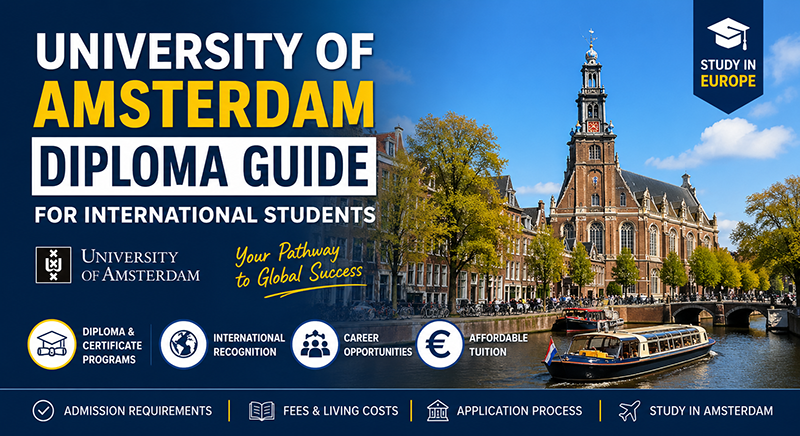
If you’re considering studying in Europe, the University of Amsterdam (UvA) is one of the most attractive options for international students. Known for its academic excellence, global reputation, and diverse programs, UvA offers a range of diploma and certificate pathways designed to support different academic and career goals.
But what exactly is a “University of Amsterdam diploma”? How does it differ from a degree? And is it worth it for international students?
This comprehensive guide answers all your questions—covering diploma programs, eligibility, tuition fees, application steps, and career outcomes.
Table of Contents
- What Is a University of Amsterdam Diploma?
- Types of Diploma Programs at UvA
- Diploma vs Degree: Key Differences
- Admission Requirements for International Students
- Tuition Fees and Living Costs
- Application Process Step-by-Step
- Popular Fields of Study
- Career Opportunities After a Diploma
- Pros and Cons of Studying a Diploma at UvA
- Tips for International Applicants
- FAQ Section
What Is a University of Amsterdam Diploma?
A University of Amsterdam diploma typically refers to short-term academic programs, certificates, or pre-degree qualifications offered by the university or its partner institutes.
Unlike full bachelor’s or master’s degrees, diploma programs are:
- Shorter in duration (3 months to 1 year)
- More focused on practical or specialized skills
- Often used as a pathway to further study
These programs are especially useful for international students who want to:
- Gain European academic experience
- Improve qualifications before applying to a degree
- Develop career-specific skills
Types of Diploma Programs at UvA
While UvA is primarily known for degree programs, it offers several diploma-style options:
Foundation and Pathway Programs
Designed for students who don’t meet direct entry requirements for a degree.
Summer School & Short Courses
Short-term academic courses in areas like:
- Business and Economics
- Social Sciences
- Humanities
- Data Science
Professional Certificates
Career-focused programs aimed at working professionals.
Exchange & Study Abroad Diplomas
Students completing exchange programs may receive certificates or diplomas of participation.
Diploma vs Degree: Key Differences
| Feature | Diploma Program | Degree Program |
|---|---|---|
| Duration | 3–12 months | 3–4 years (Bachelor’s) |
| Cost | Lower | Higher |
| Academic Depth | Basic to Intermediate | Advanced |
| Career Impact | Skill enhancement | Full qualification |
| Progression Opportunity | Pathway to degree | Direct career or further study |
Key takeaway: A diploma is a stepping stone, while a degree is a complete academic qualification.
Admission Requirements for International Students
Admission requirements vary depending on the program, but generally include:
Academic Requirements
- High school diploma or equivalent
- Relevant academic background
English Language Requirements
Most programs require proof of English proficiency:
- IELTS: 6.0–7.0
- TOEFL: 80–100
Additional Documents
- Statement of purpose
- CV or resume
- Academic transcripts
Visa Requirements
International students outside the EU will need a Dutch student visa (MVV).
Tuition Fees and Living Costs
Tuition Fees
| Program Type | Estimated Fees (EUR) |
|---|---|
| Short Courses | €500 – €3,000 |
| Summer Programs | €1,000 – €4,000 |
| Foundation Programs | €6,000 – €15,000 |
Living Costs in Amsterdam
| Expense Category | Monthly Cost (EUR) |
|---|---|
| Accommodation | €600 – €1,200 |
| Food | €200 – €400 |
| Transport | €50 – €100 |
| Miscellaneous | €150 – €300 |
Total Estimated Cost: €1,000 – €2,000 per month
Amsterdam is one of Europe’s more expensive cities, so budgeting is essential.
Application Process Step-by-Step
Step 1: Choose Your Program
Visit the official UvA website and select a diploma or short course.
Step 2: Check Requirements
Ensure you meet academic and language criteria.
Step 3: Prepare Documents
Gather transcripts, certificates, and personal statements.
Step 4: Submit Application
Apply through the university’s online portal.
Step 5: Receive Offer Letter
If accepted, you’ll receive an official admission offer.
Step 6: Apply for Visa
Non-EU students must complete visa procedures.
Step 7: Enroll and Pay Fees
Finalize your enrollment and prepare for arrival.
Popular Fields of Study
UvA diploma and certificate programs cover a wide range of disciplines:
Business & Economics
- International Business
- Finance
- Marketing
Social Sciences
- Psychology
- Sociology
- Political Science
Data & Technology
- Data Science
- Artificial Intelligence
- Digital Innovation
Humanities
- Media Studies
- Cultural Studies
- History
These fields align with global job market demand, making them attractive for international students.
Career Opportunities After a Diploma
A University of Amsterdam diploma can enhance your career prospects in several ways:
Skill Development
Gain practical, job-ready skills in a short time.
Career Advancement
Ideal for professionals looking to upskill or switch careers.
Pathway to Degree Programs
Many students use diplomas to transition into bachelor’s or master’s degrees.
Global Recognition
UvA’s strong international reputation adds value to your resume.
Pros and Cons of Studying a Diploma at UvA
Pros
- Short duration and flexible learning
- Lower cost compared to full degrees
- International exposure
- High-quality education
Cons
- Not equivalent to a full degree
- Limited job opportunities in some fields
- Competitive admission for certain programs
Tips for International Applicants
Apply Early
Programs can fill up quickly, especially summer courses.
Improve English Skills
A higher IELTS/TOEFL score increases acceptance chances.
Prepare Financially
Plan for tuition and living expenses in advance.
Consider Long-Term Goals
Use diploma programs strategically—as a pathway to a degree or career move.
FAQ Section
Does the University of Amsterdam offer official diploma programs?
Yes, UvA offers short courses, certificates, and pathway programs that function as diploma-level qualifications.
Is a UvA diploma recognized internationally?
Yes, due to the university’s strong global ranking, its diplomas and certificates are widely respected.
Can a diploma lead to a degree at UvA?
In many cases, yes. Foundation and pathway programs can help students transition into full degree programs.
How long does a diploma program take?
Typically between 3 months and 1 year.
Are scholarships available?
Some short programs offer partial scholarships, but they are limited.
Conclusion
A University of Amsterdam diploma is an excellent option for international students seeking flexible, high-quality education in Europe. Whether you want to gain new skills, boost your career, or prepare for a full degree, these programs provide a valuable stepping stone.
While they don’t replace a full academic degree, they offer strong academic credibility, global exposure, and practical learning opportunities—making them a smart choice for students in 2026 and beyond.