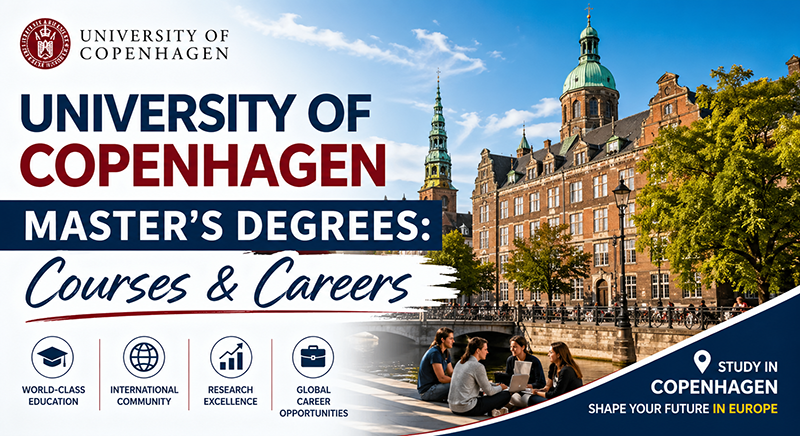
The University of Copenhagen Master’s degrees are among the most respected graduate qualifications in Europe, attracting students from all over the world. Known for its strong research culture, modern teaching methods, and global academic reputation, the university offers a wide range of master’s programs across science, health, humanities, law, and social sciences.
In this guide, we will explore everything you need to know about studying a master’s degree at the University of Copenhagen, including top courses, admission requirements, tuition fees, career opportunities, and more.
1. Overview of University of Copenhagen
The University of Copenhagen is one of the oldest and most prestigious universities in Northern Europe. Founded in 1479, it consistently ranks among the top universities globally.
It offers a wide variety of English-taught master’s programs designed for international students, especially in fields such as:
- Life Sciences
- Natural Sciences
- Social Sciences
- Humanities
- Health Sciences
- Law and Economics
The university is research-intensive, meaning students are directly involved in cutting-edge academic work.
2. Why Choose a Master’s Degree in Copenhagen?
Studying a master’s degree in Copenhagen offers several advantages:
1. World-Class Education
The University of Copenhagen is consistently ranked in the top 100 universities worldwide.
2. English-Taught Programs
Many master’s programs are fully taught in English, making them accessible to international students.
3. Strong Research Focus
Students participate in real research projects alongside professors.
4. Safe and High-Quality Living
Denmark is known for safety, social welfare, and high living standards.
5. Career Opportunities in Europe
Graduates often find jobs in Denmark, the EU, or global organizations.
3. Popular Master’s Programs
The University of Copenhagen offers a wide range of master’s degrees. Below are some of the most popular ones:
Science & Technology
- MSc in Computer Science
- MSc in Data Science
- MSc in Physics
- MSc in Geology and Geosciences
Health & Medical Sciences
- MSc in Global Health
- MSc in Pharmaceutical Sciences
- MSc in Human Biology
Social Sciences
- MSc in Economics
- MSc in Political Science
- MSc in Sociology
Humanities
- MA in English Studies
- MA in Media Studies
- MA in Cultural Data Science
4. Admission Requirements
Admission to the University of Copenhagen master’s programs is competitive.
General Requirements:
- Bachelor’s degree in a relevant field
- Strong academic record (minimum GPA equivalent to Danish 7.0 scale)
- English proficiency (IELTS 6.5+ or TOEFL 90+)
- Motivation letter
- CV or resume
- Letters of recommendation
Additional Requirements (varies by program):
- Portfolio (for design-related programs)
- GRE/GMAT (for some economics/business programs)
- Research proposal (for research-heavy degrees)
5. Tuition Fees & Scholarships
Tuition Fees
| Program Type | Annual Tuition Fee |
|---|---|
| Humanities & Social Sciences | €8,000 – €12,000 |
| Science & IT | €10,000 – €15,000 |
| Medical & Health Sciences | €12,000 – €18,000 |
EU/EEA students often study for free, while non-EU students pay tuition fees.
Scholarships
The university offers several funding options:
- Danish Government Scholarships
- Erasmus+ Exchange Funding
- Faculty-specific scholarships
- External research grants
Scholarships are highly competitive and usually awarded based on academic excellence.
6. Teaching Style & Learning Experience
The teaching style at the University of Copenhagen is very different from traditional lecture-based systems.
Key Features:
- Problem-based learning
- Group research projects
- Independent study focus
- Close professor-student collaboration
- Real-world case studies
Students are expected to be active learners rather than passive listeners.
7. Career Opportunities After Graduation
Graduates from the University of Copenhagen have strong career prospects both in Denmark and internationally.
Common Career Paths:
- Data Scientist / Analyst
- Research Scientist
- Policy Advisor
- Pharmaceutical Specialist
- Environmental Consultant
- International NGO Worker
- Academic Researcher
Top Employers:
- EU institutions
- Danish government agencies
- Google, Microsoft, and tech firms
- Pharmaceutical companies (e.g., Novo Nordisk)
- International organizations (UN, WHO)
Many international students also stay in Denmark after graduation through post-study work visas.
8. Student Life in Copenhagen
Copenhagen is one of the most student-friendly cities in Europe.
Living Experience:
- Safe and clean city
- Excellent public transport
- High quality healthcare
- Cycling-friendly environment
- Vibrant international community
Monthly Living Costs:
| Expense | Estimated Cost |
|---|---|
| Rent | €600 – €1,200 |
| Food | €250 – €400 |
| Transport | €40 – €70 |
| Miscellaneous | €200 – €300 |
Total monthly cost: €1,100 – €2,000 depending on lifestyle.
9. Comparison Table of Popular Master’s Programs
| Program | Duration | Focus Area | Career Outcome |
|---|---|---|---|
| MSc Computer Science | 2 years | AI, Software Engineering | Tech industry, Data Science |
| MSc Economics | 2 years | Finance, Policy | Banking, Government |
| MSc Global Health | 2 years | Public Health | NGOs, Healthcare orgs |
| MA Cultural Data Science | 2 years | Humanities + Data | Media, Research |
| MSc Physics | 2 years | Theoretical & Applied Physics | Research, Engineering |
10. FAQs
1. Is University of Copenhagen good for master’s degrees?
Yes, it is one of the top universities in Europe with strong global rankings and research output.
2. Are programs taught in English?
Yes, many master’s programs are fully taught in English.
3. What GPA is required?
Most programs require a strong bachelor’s degree equivalent to Danish grading standards (around 7.0 or higher).
4. Can international students work in Denmark?
Yes, students can work part-time during studies and apply for post-study work visas.
5. Is Copenhagen expensive for students?
It is relatively expensive compared to other European cities, but high-quality education and part-time work opportunities help offset costs.
11. Conclusion
The University of Copenhagen Master’s degrees offer world-class education, strong research exposure, and excellent global career opportunities. Whether you are interested in science, humanities, social sciences, or health, the university provides a diverse range of programs tailored for international students.
Studying at the University of Copenhagen is not just about earning a degree—it is about joining a global academic community and building a future career in Europe and beyond.