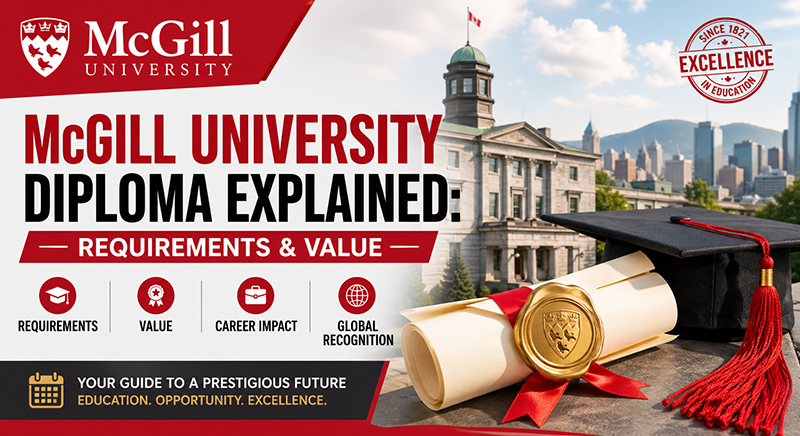
McGill University is one of Canada’s most prestigious institutions, known globally for academic excellence, research output, and strong graduate employability. For students considering studying in Canada, understanding what a McGill University diploma represents—how it is earned, what it includes, and its real-world value—is essential before making an application decision.
This guide breaks down everything you need to know about the McGill diploma, including academic requirements, graduation structure, verification processes, and career outcomes.
What Is a McGill University Diploma?
A McGill University diploma is an official academic credential awarded to students who successfully complete a degree program at the university. It confirms that the student has met all academic requirements for their specific program, whether undergraduate, master’s, or doctoral level.
The diploma is not just a certificate—it is a globally recognized qualification that signals strong academic training, critical thinking ability, and subject expertise.
At institutions like McGill University, diplomas are highly respected by employers and universities worldwide due to strict admission standards and rigorous academic evaluation.
Types of Diplomas at McGill University
McGill offers several academic pathways, and each leads to a different type of diploma:
1. Undergraduate Diploma (Bachelor’s Degree)
- Bachelor of Arts (BA)
- Bachelor of Science (BSc)
- Bachelor of Engineering (BEng)
- Bachelor of Commerce (BCom)
2. Graduate Diploma
- Postgraduate Diplomas in specialized fields
- Professional development diplomas
3. Professional Degrees
- Law (JD)
- Medicine (MD, CM)
- Management and business programs
4. Doctoral Degrees
- PhD diplomas in research-based disciplines
Each diploma reflects a different level of academic depth and career specialization.
McGill University Diploma Requirements
To earn a diploma from McGill, students must meet strict academic and administrative requirements.
1. Credit Completion
Students must complete a specific number of credits depending on their program:
- Undergraduate: typically 90–120 credits
- Graduate: varies by program (24–45+ credits)
2. Required Courses
Each program includes:
- Core mandatory courses
- Program-specific electives
- Capstone or research projects (in many cases)
3. Minimum GPA Requirement
Students must maintain a minimum academic standing:
- Usually around a 2.0–3.0 GPA scale depending on faculty
4. Residency Requirement
Students must complete a portion of their studies directly at McGill University (not transferred credits).
5. Language Proficiency
As McGill is bilingual (English/French environment), some programs may require language competency.
6. Final Approval
Degrees are reviewed and approved by the faculty before diploma issuance.
McGill Graduation Process Explained
The graduation process is structured and highly formalized:
Step 1: Program Completion
Students must complete all required coursework and credits.
Step 2: Degree Audit
Academic advisors verify graduation eligibility.
Step 3: Application to Graduate
Students officially apply to be considered for graduation.
Step 4: Faculty Review
Each faculty evaluates and approves student records.
Step 5: Convocation Ceremony
Graduates receive recognition at McGill’s official convocation.
Step 6: Diploma Issuance
The physical and digital diploma is issued after confirmation.
What Does a McGill Diploma Look Like?
A McGill diploma typically includes:
- Student’s full legal name
- Degree title (e.g., Bachelor of Science)
- Faculty name
- University seal and signatures
- Date of conferral
It is an officially certified document and often required for:
- Job applications
- Immigration processes
- Further academic studies
McGill Diploma vs Transcript: Key Differences
| Feature | Diploma | Transcript |
|---|---|---|
| Purpose | Confirms degree completion | Shows detailed grades |
| Content | Degree title only | Full course history |
| Use | Employment & certification | Academic evaluation |
| Format | Single official document | Multi-page record |
Both documents are important, but the diploma carries higher symbolic and professional weight.
Is a McGill University Diploma Worth It?
A McGill diploma is widely regarded as highly valuable for several reasons:
1. Global Reputation
McGill consistently ranks among the top universities worldwide.
2. Strong Employer Recognition
Graduates are recruited by top companies in:
- Finance
- Technology
- Engineering
- Healthcare
- Government and policy
3. Research Excellence
McGill is known for cutting-edge research opportunities.
4. Alumni Network
Graduates join a global alumni network with strong career connections.
5. High Return on Investment
Many graduates experience strong salary growth within a few years.
McGill Diploma Verification Process
Employers and institutions can verify a McGill diploma through official channels.
Verification Methods:
- Direct university verification system
- Official transcript requests
- Secure digital verification services
This helps prevent fraud and ensures academic authenticity.
McGill Diploma for International Students
International students often choose McGill because:
- It offers globally recognized degrees
- Strong post-graduation work opportunities in Canada
- Pathways to permanent residency
- Multicultural campus environment
However, international students must meet:
- Visa requirements
- English/French proficiency standards
- Academic eligibility criteria
Career Outcomes After McGill Graduation
McGill graduates typically pursue careers in:
Business & Finance
- Investment banking
- Consulting
- Corporate strategy
Technology
- Software engineering
- Data science
- AI research
Healthcare
- Medicine
- Public health
- Biomedical research
Law & Policy
- Legal practice
- International relations
- Government roles
Average graduate outcomes are among the strongest in Canada.
Challenges of Earning a McGill Diploma
While prestigious, earning a McGill diploma is not easy:
- High academic workload
- Competitive grading system
- Intensive exams and projects
- Strong time management required
Students must be academically disciplined and consistent.
Tips to Successfully Earn a McGill Diploma
- Stay organized with coursework deadlines
- Use academic advising services
- Participate in study groups
- Maintain consistent GPA performance
- Seek internships and research opportunities early
Frequently Asked Questions (FAQ)
1. Is a McGill diploma internationally recognized?
Yes, McGill diplomas are globally recognized and respected by employers and universities.
2. How long does it take to earn a McGill diploma?
Typically 3–4 years for undergraduate degrees and 1–3 years for graduate programs.
3. Can international students get a McGill diploma?
Yes, international students are fully eligible if they meet admission and graduation requirements.
4. Is McGill hard to get into?
Yes, admission is competitive with strong academic requirements.
5. Can I verify a McGill diploma online?
Yes, verification is possible through official university systems.
6. Does McGill provide digital diplomas?
Yes, many programs now offer secure digital credential options.
Conclusion
A McGill University diploma represents far more than academic completion—it is a globally respected credential that opens doors to top-tier careers, advanced studies, and international opportunities. While the academic journey is demanding, the long-term value in terms of career prospects and global recognition makes it one of the most rewarding degrees in Canada.
For students aiming for excellence, McGill remains a powerful academic and professional investment.