
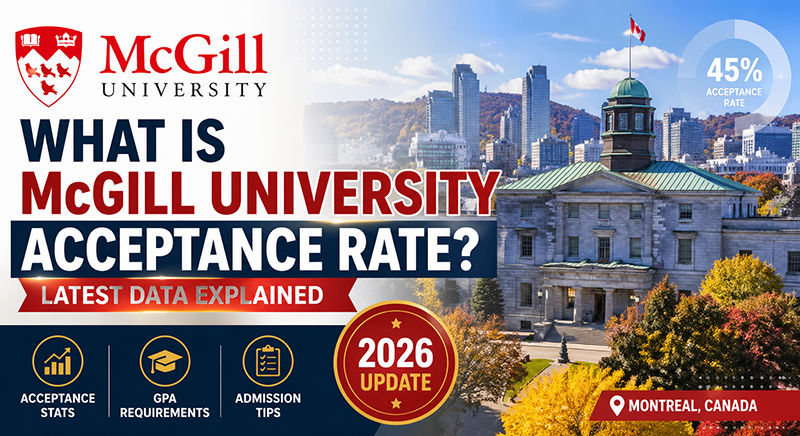
McGill University is one of Canada’s most prestigious institutions, attracting students from all over the world. Located in Montreal, it is known for its rigorous academics, competitive admissions, and strong global reputation. But one of the most frequently asked questions by applicants is: What is the McGill University acceptance rate?
In this comprehensive guide, we break down the latest acceptance rate data, admission difficulty, GPA expectations, program competitiveness, and strategies to improve your chances of getting in.
Overview of McGill University
McGill University is a public research university located in Montreal, Quebec, Canada. Founded in 1821, it consistently ranks among the top universities globally and is often considered the “Harvard of Canada.”
Key highlights:
- Over 300+ programs across faculties
- Highly international student body (150+ countries)
- Strong reputation in medicine, law, engineering, and business
- Highly competitive admissions process
Because of its global reputation, admission is highly selective, especially for international applicants.
What Is McGill University Acceptance Rate?
The McGill University acceptance rate typically ranges between:
39% – 46% overall (varies by year and program)
However, this number can be misleading because admission difficulty varies significantly by faculty.
General Breakdown:
- Overall acceptance rate: ~40%
- International students: ~30%–35%
- Highly competitive programs: 10%–25%
This means McGill is selective but not impossible, especially compared to Ivy League schools in the U.S.
McGill Acceptance Rate by Program
Not all programs at McGill have the same level of competitiveness.
1. Engineering
- Acceptance rate: ~20%–25%
- Requires strong math and physics background
- High GPA expectation (85%+ or equivalent)
2. Desautels Faculty of Management (Business)
- Acceptance rate: ~30%–40%
- Competitive for international students
- Strong emphasis on academics + extracurriculars
3. Faculty of Science
- Acceptance rate: ~35%–45%
- Moderate to high competition depending on major
4. Faculty of Arts
- Acceptance rate: ~45%–55%
- One of the more accessible faculties
5. Medicine (very competitive)
- Acceptance rate: ~5%–10%
- Requires prior undergraduate degree + MCAT
Is McGill Hard to Get Into?
Yes—McGill is considered highly competitive, especially for international applicants.
However, compared to universities like Harvard or Stanford, McGill has:
- Higher acceptance rates overall
- More transparent academic thresholds
- Less emphasis on holistic essays (varies by faculty)
What makes McGill difficult?
- High GPA requirements
- Limited spots in top programs
- Strong global applicant pool
- Competitive scholarships and funding
McGill GPA Requirements
Admission is heavily based on academic performance.
Typical GPA Expectations:
- Minimum competitive GPA: 3.3 / 4.0 (approx. 85%)
- Top programs: 3.7+ / 4.0 (90%+ equivalent)
International grading systems are converted carefully, but McGill expects top-tier academic consistency.
McGill Acceptance Rate for International Students
International applicants face slightly tougher competition:
- Estimated acceptance rate: 30%–35%
- Higher academic thresholds than domestic applicants
- Strong English/French proficiency required
Applicants from countries with competitive grading systems (China, India, U.S., UK) often need stronger academic profiles to stand out.
Factors That Affect Admission Chances
McGill evaluates students based primarily on academics, but other factors still matter:
1. Academic Performance
Your grades are the most important factor.
2. Course Rigor
Advanced placement, IB, A-levels, or honors courses help significantly.
3. Program Demand
Some majors are significantly more competitive.
4. Language Proficiency
- TOEFL / IELTS required for non-English backgrounds
- French may be required for certain programs
5. Extracurricular Activities
Less important than U.S. universities, but still helpful for competitive programs.
McGill vs Other Canadian Universities
| University | Acceptance Rate | Difficulty Level |
|---|---|---|
| McGill University | 39–46% | High |
| University of Toronto | 40–43% | Very High |
| University of British Columbia | 45–55% | High |
| University of Alberta | 50–60% | Moderate |
McGill sits firmly among the top 3 most competitive universities in Canada.
How to Improve Your Chances of Getting Into McGill
If you want to increase your chances, focus on:
1. Maintain High Grades
Aim for top 10% of your class.
2. Take Challenging Courses
AP, IB, or honors courses are strongly recommended.
3. Choose Strategic Programs
Some faculties are significantly easier to enter.
4. Prepare Early
Start applications and language tests early.
5. Strong Academic References
Teacher recommendations matter in competitive cases.
Common Misconceptions About McGill Admission
“McGill is easy to get into”
Not true—top programs are extremely competitive.
“Only extracurriculars matter”
False—McGill is primarily academic-focused.
“International students have no chance”
Incorrect—many international students are admitted each year, but standards are high.
FAQs About McGill Acceptance Rate
1. What is McGill University acceptance rate in 2026?
The estimated acceptance rate is around 39%–46% overall, depending on the program.
2. Is McGill harder to get into than University of Toronto?
Both are highly competitive, but Toronto is generally considered slightly more selective.
3. What GPA do I need for McGill?
A competitive GPA is typically 3.3–3.8+ (85%–90% equivalent) depending on the program.
4. Does McGill accept international students easily?
Yes, but competition is strong. International acceptance rate is about 30%–35%.
5. What is the hardest program to get into at McGill?
Medicine, Engineering, and Desautels Management are among the most competitive.
Final Thoughts
The McGill University acceptance rate shows that while admission is competitive, it is still achievable for strong students with solid academic performance. Understanding program-specific requirements, GPA expectations, and strategic application planning can significantly improve your chances.
If you’re targeting McGill, focus on academic excellence first—everything else builds around it.