
Introduction
When applying for jobs, graduate schools, or international opportunities, academic credentials play a crucial role in defining your qualifications. Two of the most commonly confused documents are the diploma and the transcript, especially when issued by prestigious institutions like Princeton University.
While both documents confirm academic achievement, they serve very different purposes. Understanding the distinction between a diploma and a transcript is essential for students, employers, and academic institutions alike.
This guide breaks down everything you need to know about Princeton University diploma vs transcript differences, including usage, verification, content, value, and real-world applications.
What Is a Princeton University Diploma?
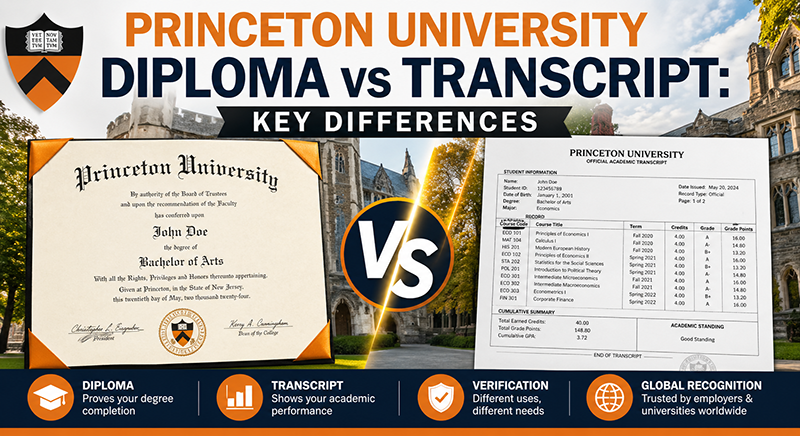
A diploma from Princeton University is an official certificate awarded upon successful completion of a degree program.
It typically includes:
- Student’s full name
- Degree awarded (e.g., Bachelor of Arts, Master’s, PhD)
- University name (Princeton University)
- Graduation date
- Official signatures and seals
Key Purpose of a Diploma
A diploma is primarily a symbolic certification of degree completion. It confirms that a student has officially graduated but does not include academic performance details.
What a Diploma Does NOT Show
- Course-by-course grades
- GPA
- Academic progression
- Credit breakdown
What Is a Princeton University Transcript?
A transcript is a complete academic record issued by Princeton University that details a student’s entire academic performance.
It includes:
- All courses taken
- Grades received
- Credit hours
- GPA (Grade Point Average)
- Academic standing (honors, probation, etc.)
- Semester-by-semester breakdown
Key Purpose of a Transcript
A transcript is used to verify academic performance and competency rather than just graduation status.
Key Differences: Diploma vs Transcript
| Feature | Diploma | Transcript |
|---|---|---|
| Purpose | Confirms graduation | Shows academic performance |
| Detail Level | Basic | Highly detailed |
| Includes Grades | No | Yes |
| Includes GPA | No | Yes |
| Use Case | Symbolic proof of degree | Job & academic evaluation |
| Issued When | At graduation | Anytime upon request |
When You Need a Diploma
A Princeton diploma is commonly used for:
1. Employment Verification
Employers may request proof of degree completion.
2. Personal Achievement
A diploma is often displayed in offices or homes as a symbol of success.
3. Immigration Applications
Some visa processes require proof of graduation.
4. Professional Licensing
Certain regulated professions require a degree certificate.
When You Need a Transcript
A transcript is required for:
1. Graduate School Applications
Universities use transcripts to evaluate academic ability.
2. Scholarships
Academic merit is judged based on grades and GPA.
3. Job Applications
Especially for competitive roles (finance, tech, academia).
4. Credential Evaluation
International equivalency assessments require transcripts.
Which One Is More Important?
The answer depends on your goal:
- For proof of graduation → Diploma is enough
- For academic evaluation → Transcript is essential
In most real-world scenarios, transcripts carry more analytical weight, while diplomas carry more symbolic value.
Verification Differences
Diploma Verification
- Confirms degree authenticity
- Verified through university registrar
- Used for background checks
Transcript Verification
- Confirms academic performance accuracy
- Used for detailed credential evaluation
- Often required by third-party agencies
Common Misunderstandings
“Diploma shows my GPA”
False. Only transcripts include GPA.
“Transcript replaces diploma”
No. Both serve different functions.
“Employers only need diploma”
Not always. Many employers require transcripts too.
Princeton University Academic Reputation
Princeton University is one of the world’s most prestigious Ivy League institutions, known for:
- Rigorous academic standards
- Low student-to-faculty ratio
- Strong research programs
- Global alumni influence
Because of this reputation, both diplomas and transcripts from Princeton carry significant global recognition.
Real-World Scenario Comparison
Scenario 1: Job Application
- Employer requests diploma → Proof of graduation
- Employer requests transcript → Skill evaluation
Scenario 2: Graduate School
- Transcript required (primary document)
- Diploma optional
Scenario 3: Immigration
- Diploma often required
- Transcript may support application
Digital vs Physical Documents
Diploma
- Usually physical parchment certificate
- Hard to replace
- Often framed
Transcript
- Digital + official printed versions
- Can be requested multiple times
- Frequently updated format
Importance in Career Growth
Both documents contribute differently to career development:
- Diploma = Entry qualification
- Transcript = Competency proof
Top employers often evaluate both together for a complete academic profile.
Frequently Asked Questions (FAQ)
1. What is the difference between a diploma and a transcript?
A diploma confirms graduation, while a transcript shows detailed academic performance.
2. Does Princeton University give both diploma and transcript?
Yes, Princeton University issues both official documents to graduates.
3. Which is more important for jobs?
Most employers prefer transcripts for skill evaluation, but diplomas are required for degree proof.
4. Can I use a transcript instead of a diploma?
No. They serve different purposes and are not interchangeable.
5. Is a Princeton diploma valuable internationally?
Yes, Princeton diplomas are globally recognized and highly respected.
6. Do transcripts include GPA?
Yes, transcripts include GPA and full academic history.
7. Can I request a transcript after graduation?
Yes, alumni can request official transcripts anytime.
8. Which document do graduate schools require?
Most graduate programs require official transcripts, not just diplomas.
Conclusion
Understanding the difference between a Princeton University diploma and transcript is essential for students navigating academic and professional pathways.
While the diploma serves as official proof of graduation, the transcript provides a deeper insight into academic performance and capabilities. In most professional and academic contexts, both documents work together to create a complete picture of a student’s achievements.
If you are planning for jobs, graduate school, or international opportunities, knowing when to use each document can significantly improve your application success.